| Tarot context: Arthur M. Hind in his "Early Italian Engravings", 1938,
gives the information, that Michel Wolgemut made woodcut copies or adaptations of the motifs of the socalled Mantegna Tarocchi for a finally
unpublished work of the editor Peter Danhauser, Archetypus Triumphantis Romae, between the years 1493 - 1497. From Dürer, in the years
1486 - 1490 pupil of Wolgemut, it is assumed that he painted at least a part of his pen paintings of the Mantegna Tarocchi in 1495 during his visit
of the city of Venice - it's unknown, if his not completed work has a relation to the book project of Danhuber and Wolgemut.
According to Michael Hurst the woodcuts of Wolgemut contained motifs of the Mantegna Tarocchi and motifs of Petraca's Trionfi series.
According to Hind the existent woodcuts contained the Mantegna Tarocchi motifs Nos. 11, 12, 13, 15, 17, 18, 19, 22, 27, 28, 29, 34, 35, 37, 39 and 42. |
Michel Wolgemut
Son of the painter (?) Valentin Wolgemut, started to wander as a painter around 1450 (probably in Flandern) and was before 1471 in Munich in the workshop of Gabriel "the painter of Munich" (probably Gabriel Mäleskircher), where he tried to marry Magdalena, the daughter of the painter, which was promised to him, but he was refused finally and lost in a process. In 1473 he married the widow of the Hans Pleydenwurff (ca. 1420 -1472), the major artist in Nuremberg, whose workshop he took in cooperation with the son of the painter, Wilhelm Pleydenwurff. Although as artist considered to be of lower quality than Pleydenwurff, he established successfully as leading workshop in the city, engaged in religious paintings and woodcarvings, even stained glass windows. His major contribution, however, became (working in cooperation with his partner Wilhelm Pleydenwurff) about 1800 different woodcuts in the famous "Weltchronik" of Schedel. In 1493 already about 60 years old, Wolgemut reached an high age and stayed active till his death in 1519 (his partner Wilhelm Pleyendorff died 1494.
Peter (or Petrus) Danhauser
Rather unknown, called a "humanistic professor", said to have died 1515. He is noted variously as editor from 1489 - 1497
- 1489: Was involved in the Nuremberg production (after November 1489) of Fidelis Cassandra: Oratio pro Bertucio Lamberto (1487). The Nuremberg edition contained beside the main text some letters (one from Peter Danhauser, Nuremberg 22th November 1489), a poem from Pescennius Franciscus Niger, an ode of Conradus Celtis and a woodcut of Albrecht Dürer (info to Fidelis Cassandra, early Italian "feminist", engaged for the higher education of women)
- 1490: was editor of Repertorium auctoritatum Aristotelis et aliorum philosophorum. - With: Auctoritates Ciceronis. – Valerius Maximus: Facta et dicta memorabilia <Ausz. Lib. 5> De Marco Cicerone. – With a dedication to Sebald Schreyer, Nürnberg 26. 7. 1490, with epitaph on Cicero (Walther, Initia 7951 und 7975) and poem Tingere dispositis chartas. Printed in Nuremberg, Peter Wagner [c. 1491-92] 4°
- 1490: was editor: Barbarus, Hermolaus (the younger): Oratio ad Fridericum III. imperatorem et Maximilianum I. regem Romanorum. Brügge, 1486. 08. 03. - Contains: Gratiadei, Antonius: Responsio extemporanea ad Hermolaum Barbarum. With letter from Hermolaus Barbarus to Johannes Carondeletus, Brügge 4. 8. 1486, and the answer, Brügge 9. 8. 1486. - Brunus, Ludovicus: Gratulatio de Maximiliani Romanorum regis coronatione. - with dedication letter to Konrad Stepeck, Nürnberg 2. 3. 1490, printed Nürnberg: Peter Wagner, nach 1490. 04. 02.] 4°
- 1491: was editor. Anselmus (Anselm of Canterbury). Opera, printed by Caspar Hochfeder
- 1494: was editor of Thomas von Kempen: Opera, printed in Nürnberg by Kaspar Hochfeder, 29.XI. 1494. The edition contained an addition of Georg Pirckamer (relative of Willibald Pirckheiner ?); [Thomas von Kempen (1379 - 1471), German mystic from the lower Rhine, info]Katalogisat erstellt: © Franziskaner Schwaz
- 1495: was editor Jacobus (de Gruytrode) : Specula omnis status vitae humanae. With dedication letter to Georg Pirckheimer, Nürnberg 19. 1. 1495, printed Nürnberg: Peter Wagner, 1495. 01. 28. 4° [Jacobus de Gruytrode died 1472]
- 1496: was editor: Guillermus Alvernus, Episcopus Parisiensis. Opera. With table by Johann Rosenbach. Printed in Nuremberg: Georg Stuchs, after 31 March 1496
The following is rather curious:
In German language an older folksong of Ludwig Uhland (1787 - 1862) exists, perhaps based on an earlier version. The text with sexual symbols about a "Knight Danhausen", who has love with Lady Venus, but feels tempted to visit the pope to enter his service and to get forgiveness for his sins. The dialog pope/Danhausen ends with Danhausen returning to Venus, a dry stick getting leaves again and the pope wondering, where Danhausen is gone to. The song or poem seems to have reinterpreted in this satirical text from 1849 (the Ludwig Uhland version is given in the notes).
"Danhausen" is a rare German name, there are not much persons with this name.
In the context of the above mentioned never fulfilled bookproject, which was prepared 4 long years with various activities by more than one person, but never was printed., and which contained a sort of papal Trionfi game, (see above), the folksong looks like a joke about the real person Danhausen, who ended his career as an editor just after this project, as it seems (perhaps the whole operation was connected to a financial desaster ?). Early German humanists were famous for her creativity in matters of mockery - perhaps this is the hidden meaning of Ritter Danhausen's adventure?
A never realised book project
text in progress
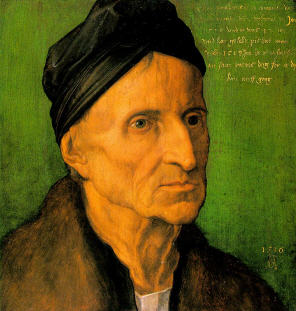
Michel Wolgemut 1516, 82 years old
painted by Albrecht Dürer
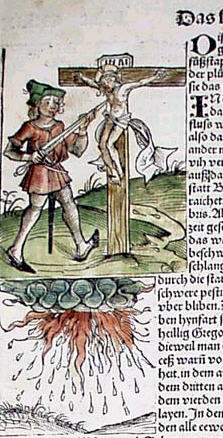
Weltchronik of Schedel
produced 1490 - 1493
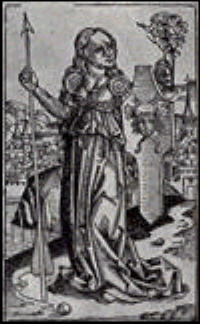
Philosophia / Mantegna Tarocchi
woodcut of Wolgemut