Il Tarocchino di Bologna
|
|
The Tarot Cards of Bologna.
History, Iconographs and Prophecy.
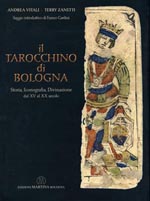
From the 15th ? 20th century. By Andrea Vitali and Terry Zanetti. Introduction by Franco Cardini. The work entitled "Il Tarocchino di Bologna. Storia. Iconografia. Divinazione. Dal XV al XX secolo"(180 pages with 328 color photos and 19 black and white photos, Editor Martina, Bologna) published under the aegis of the city of Bologna was assembled by Andrea Vitali and the historian Terry Zanetti, expert on popular tradition. It is the result of several years of research that was conducted in the most revered cultural institutions of Bologna such as the Library of Achiginnasio, the State Archive, the University Library and the Medieval Civic Museum. This volume includes a very detailed documentation that sheds new light on the origin of cards that Andrea Vitali believes date back to the first decade of the 15th century and most likely can be attributed to the city of Bologna. This theory is based not only on a series of documents but also on the iconographic analyses of various antique tarot cards from Bologna that display symbolism and allegories quite similar to those present in Bologna's religious and secular art of the 15th century. The cities of Ferrara and Milan have long been accepted as the homes of tarot but, this new theory supported by documents, could prove to be important for Bologna. Should it be proven, it would mean that this game, based on the art of memory (ars memoriae) and filled with philosophical Christian mystical content originated in this Bologna. This theory is further supported by the frescos found in the Basilica of San Petronio (Bolognini Chapel) and by the 17th century painting depicting Prince Francesco Antelminelli Castracani Fibbia who lived during the 15th century and who is identified in the painting by a note on the canvas that reads "Inventor of Tarocchini Cards". Although the prince was long assumed to be a legendary character, Andrea Vitali was able to locate documents that prove his actual existence and trace his movement from his birthplace in Tuscany to Bologna. For the chapter on Prophecy, Terry Zanetti accurately researched the tradition that is linked to prophecy. His research started with a tarot card document (dating back to the first half of the 18th century) from Bologna found in the University library. Zanetti compared the tarot card interpretations found in this document with those found in various card decks dating from the second half of the 1700s, the mid-1800s and the beginning of the 1900s. From there she was able not only to reconstruct the history of significant tarot prophets but to construct informative descriptions for each card and prophecy based purely on tradition without the prophetic attributes later added in the 1900s that lacked the original traditions from Bologna. The images in this volume come mainly from a documentary collection (antique cards, paintings and incisions) belonging to "Le Tarot", a cultural organization headed by Prof. Andrea Vitali that conducts historical and symbolic studies and who's members include many distinguished professors of medieval history, philosophy, religion and anthropology. Other photos are taken from documents retrieved from the Library of Archiginnasio, the State Archive and the Medieval Civic Museum. Some photos were also taken of card decks that were loaned to us by private collectors in Bologna. This work will surely fill a great academic gap. Up until now there have been no in-depth studies of tarot cards in Bologna that did not concentrate exclusively on the aspects of the game. This volume will be a fundamental periodical not only for the content and the philological research that went in to it but also for the important visual component. INTRODUCTION By Franco Cardin Prof. Cardini outlines the historical importance of tarot cards which are considered the most complete medieval symbolic system. He also covers the anthropological value of their prophetic aspects. PART ONE: THE HISTORY By Andrea Vitali Ludus Triumphorum and Tarot Cards In this chapter, Prof. Vitali presents a general summary beginning with the history of tarot, or "Triumphs" ("Trionfi") as they were called in the 1400s. He then moves on to the meaning that was associated with the four signs (money, cups, clubs and swords) and the word "tarot", a term that appeared in the 1500s. Finally, he explains the relationship between the game and the so- called "Medieval Mystic Staircase" as well as other influences that existed between the numerological tarot structure and eastern theology. Triumphs, Tarot and Tarocchini in Bologna: 1400-1900 In this chapter, the author elaborates on the history of tarot in Bologna and discusses the most recent historical discoveries.
By Terry Zanetti
PART THREE ? TEXT Edited by Andrea Vitali Collection of original and integral documents all related to the history of tarot cards and the "tarocchini" of Bologna. (presented by Associazione LeTarot)
| 
|